
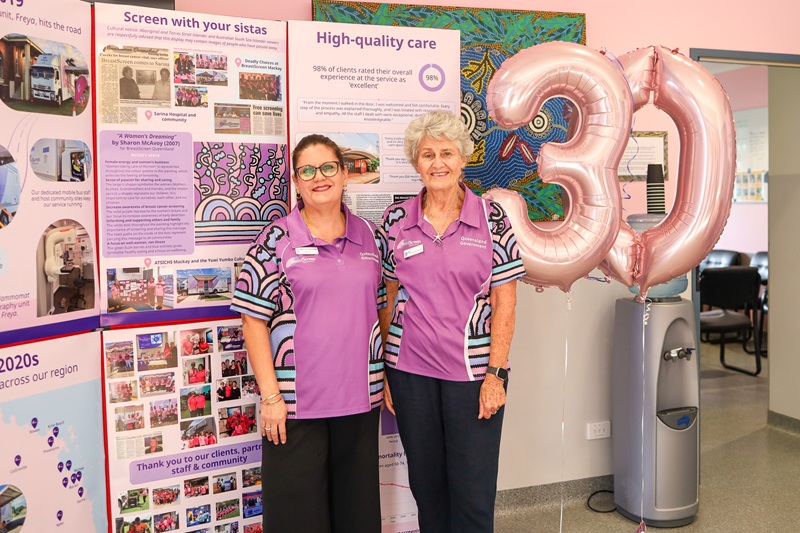
Thirty years, more than 225,000 screens and 1,274 diagnoses; but the true measure of BreastScreen Mackay’s impact can’t be counted in numbers alone.
Since opening its doors in 1996, the service has helped generations of women across the region access early detection, peace of mind and, for some, a diagnosis that changed their lives.
The 30th anniversary of BreastScreen Mackay was marked with a small celebration at the Wellington Street facility yesterday. The event was attended by Member for Mackay Nigel Dalton, Mackay Regional Council Mayor Greg Williamson, current and previous BreastScreen staff and Mackay Hospital and Health Service clinicians and staff.
BreastScreen Mackay clinical director Dr Wendela Schimmer said the milestone recognised three decades of clinical achievements, technological advances and community partnerships, while honouring the regional women whose lives have been touched by the service.
“When the service commenced, mammograms were captured on film and processed in a darkroom. In its first year, 1985 women were screened here in Mackay,” Dr Schimmer said.
“Today, more than 225,000 breast screens have been performed by the service, along with more than 14,300 assessment attendances and 1274 diagnoses.”
Between 1996 and 2005, 53,801 screenings were recorded at the Mackay facility which increased to 76,618 between 2006 and 2015, and a further 87,685 between 2016 and 2025.
BreastScreen Mackay had undergone significant changes over three decades, Dr Schimmer said.
“One of the biggest changes was in 2010 when film mammography was replaced with digital technology, meaning images could be transferred and reviewed electronically rather than physically transported and viewed on a lightbox,” she said.
The service has continued to embrace innovation, with a Hologic Selenia Dimensions system incorporating 3D breast tomosynthesis installed at the clinic in 2018.
Mobile screening has also been central to reaching women outside Mackay; the service's mobile screening bus, Freya, took to the road in 2019.
Since then more than 20,000 screening attendances have taken place aboard Freya, which was also upgraded with a Siemens Mammomat Revelation mammography unit in 2023.
“Today, thousands of women in rural communities across the region access screening through the mobile service each year,” Dr Schimmer said.
In 2024, the service expanded its catchment to include Bowen and Collinsville, further strengthening access to lifesaving screening across the Mackay Hospital and Health Service (HHS) region.
But the service’s work goes far beyond technology to include education and building community partnerships.
“The service also continues to encourage eligible women to overcome common barriers to screening, including cultural barriers, fear and the belief that screening is unnecessary if you don’t have a family history of breast cancer,” Dr Schimmer said.
“Early detection through screening remains one of the most important tools in the fight against breast cancer.”
The impact of early detection could be seen in declining breast cancer mortality among women aged 50 to 74, Dr Schimmer said, which has fallen from about 75 deaths per 100,000 women in 1985 to around 35 per 100,000 in 2025.
Around one in seven Australian women will be diagnosed with breast cancer during their lifetime, while nine out of 10 women diagnosed do not have a family history of the disease, she said.
BreastScreen Mackay’s 30th anniversary celebration featured speeches reflecting on the service's history, a cake cutting, a plaque reveal and the launch of the Sista Shawls initiative.
A large photo display in the foyer of the facility took event attendees on a journey from 1996 to today, showcasing the people, technology, mobile services and milestones that have shaped BreastScreen Mackay.
And while much has changed in three decades, the purpose and importance of screening remains the same, Dr Schimmer said.
“Every screening represents an opportunity to detect breast cancer early, when treatment can be more effective.”
For women aged 40 and over, BreastScreen provides free screening every two years, with women aged 50 to 74 actively invited to participate.