
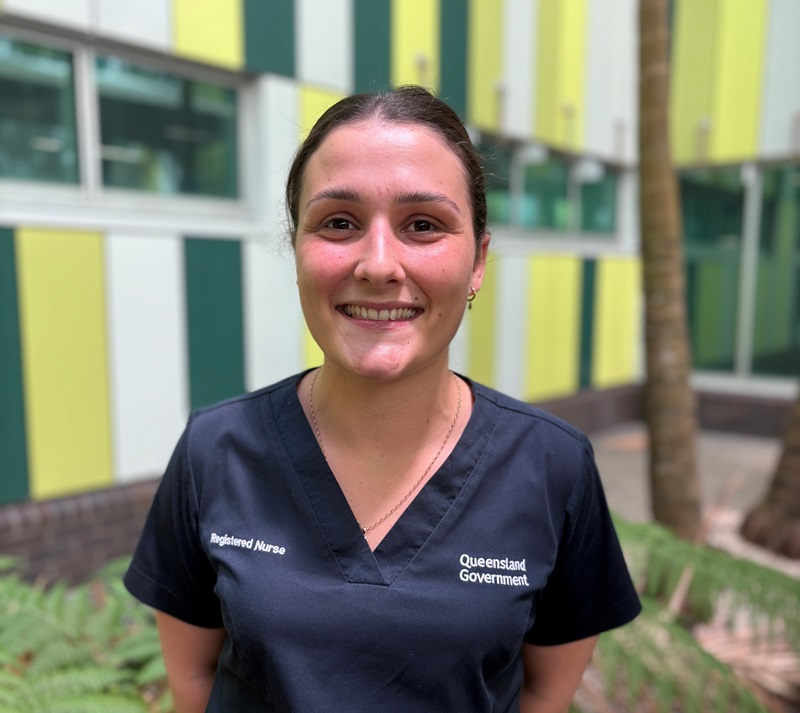
Fast, unpredictable and sometimes confronting; working in an Emergency Department (ED) takes resilience, adaptability and empathy.
For Grace Metten, it’s exactly where she wants to be and the unpredictability is part of the appeal.
The acting clinical nurse consultant (CNC) has spent almost five years working in the Mackay Base Hospital ED and says she thrives on the pace.
“It’s definitely a high-pressure job. There’s a lot of adrenaline and it’s very fast-paced,” Grace said.
“You get a lot of satisfaction quickly as an ED nurse when things go well.
“You get to see patients clinically improving right in front of you. It sometimes happens rapidly, but just as rapidly they can also decline.
“It’s busy, it’s fast-paced and you’re on the go all the time - and that’s pretty much me.”
Grace knew early on she wanted to be a nurse. She started at Mackay Base Hospital as an Assistant in Nursing (AIN) while studying at CQ University, working across medical and orthopaedic wards before graduating. Her postgraduate year saw her working in Collinsville, Dysart and Proserpine as a rural reliever, before she found her way to the ED.
It was placements in the Intensive Care Unit (ICU) and Coronary Care Unit (CCU) which sparked her interest in critical care.
“I really liked the critical thinking required and the fast pace of ED,” she said.
Five years on, it’s the variety that keeps her coming back.
“There’s no regular day in ED,” Grace said.
“Trauma, chest pain and sepsis are some of our biggest presentations, as well as mental health clients in crisis.
“We also see a lot of elderly people with co-morbidities (two or more medical conditions) or those who have had accidents and falls.”
Working at the frontline of healthcare means seeing people at some of the worst moments of their lives. And that can be tough.
“One of the biggest challenges for us is switching off after a shift,” Grace said.
“Nurses can burn out quickly in ED. It’s continuous high-pressure so that can be very challenging.”
Grace said the Mackay Base Hospital ED provided many career advantages, including the opportunity to build nursing skills quickly.
While nurses in larger tertiary hospitals could sometimes wait years for opportunities to work in resuscitation or triage, the Base hospital’s broad mix of presentations meant staff were exposed to a wide range of clinical situations.
“People can upskill and progress quicker here because they’re exposed to so much more variety, including trauma and paediatric cases,” she said.
“Mackay is a great place to upskill in resus or triage and to progress your career.”
But clinical skills are only part of the job. Grace believes the best ED nurses need a “thick skin” and a soft heart.
“You’ve got to be tough, but you also need empathy for people,” she said.
“You need to be willing to show an appropriate level of professional vulnerability with patients. It often builds trust and contributes to a better patient experience.
“We’re all human and that can make a patient feel a little more connected during a tough time.”
With around 140 nursing staff in the ED, Grace said teamwork was critical, particularly when the pressure is on.
“Critical thinking and problem solving are important skills but so is teamwork and the ability to connect with others,” she said.
As acting CNC, Grace has another opportunity to make a difference with her scope, including clinical management, policies, procedures and quality improvement.
“It’s a role that focuses on how we can make further improvements for both our staff and our patients,” she said.
“I really enjoy frontline patient care, so I could never walk away from that."