
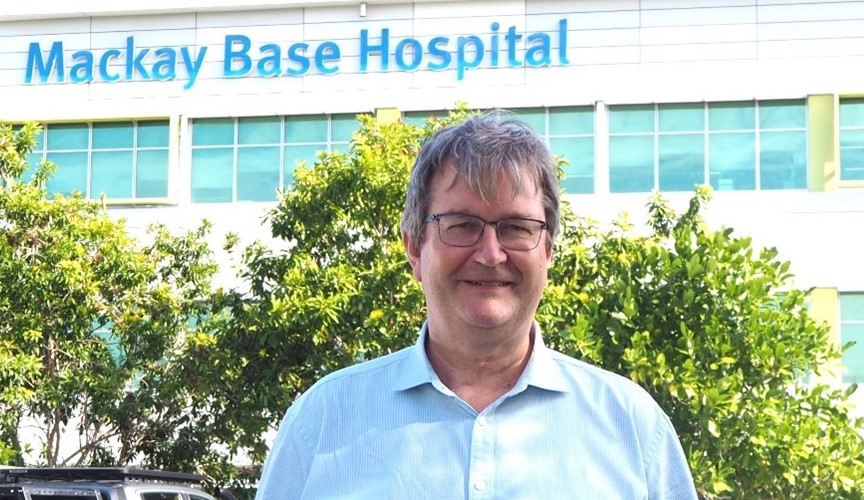
A revolutionary blood test developed by a Mackay Hospital and Health Service (HHS) gastroenterologist is poised to transform coeliac disease, offering patients a less invasive path to diagnosis.
Mackay HHS gastroenterologist and biotech co-founder and director Dr Robert Anderson said the antigen-specific T-cell blood test eliminates the need for patients to undergo a gastrointestinal endoscopy.
“Potentially, you no longer have to do that,” Dr Anderson said.
“You can just draw blood and you can measure the immune response in a blood sample. There's no real need to eat gluten and it actually turns out that the immune response in the blood is, if anything, stronger in people who are on a gluten-free diet,” he said.
Current diagnosis for the disease requires patients to consume a diet high in gluten prior to having a gastroscopy.
This is often met with resistance by patients due to uncomfortable symptoms experienced like nausea, pain and bloating.
“It’s removing a big barrier to them getting a correct diagnosis - an accurate diagnosis for people on a free diet has huge implications,” Dr Anderson said.
The test has proved highly successful in a recent clinical trial, with results published in the Journal of Gastroenterology.
The test identifies an immune system marker, which spikes when blood from someone with coeliac disease is exposed to gluten in a test tube.
Currently progressing through clinical trials, the test is set to revolutionise the diagnostic process, Dr Anderson said.
“The results demonstrate high accuracy of the test for diagnosing coeliac disease,” he said.
“The biggest public health issue around coeliac disease is the accurate diagnosis and finding all these people in the community who actually have coeliac disease and then making sure that they get the treatment that we already know about, which is a gluten-free diet.”
“The thing that really seems to have resonated with a lot of people around the world, particularly the doctors, is to have a good diagnosis.”
Dr Anderson believes the test will also help to identify patients who have been incorrectly diagnosed with the disease.
“The gluten-free diet probably costs around three thousand dollars or more per year, which is extreme,” he said.
“You don’t go to social events, you mistrust everything and you’re burdening the person and the family with psychological issues.
“And (in the case of an incorrect diagnosis) it’s unnecessary. This is the other side of the blood test that you can perhaps unravel,” he said.
The test also shows potential for diagnosing other autoimmune diseases and conditions involving immune reactions.
In addition to his clinical and commercial roles, Dr Anderson is the current President of the International Society for the Study of Celiac Disease – a fitting role after more than 20 years’ contributing to coeliac disease research.
He has recently returned from Finland where he was presented with the prestigious Maki Celiac Disease Tampere Prize, an award which acknowledges an individual whose research has made a significant contribution to the fields of coeliacdisease and other gluten-induced disease entities.
An international review committee of experts selected him as the winner based on his/her clinical, translational and transformative research.