
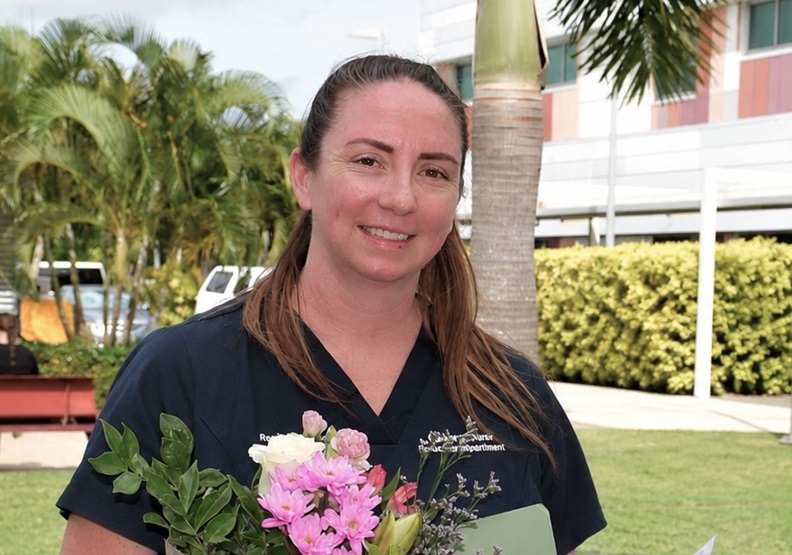
For Samantha Bullman, her patients are like family.
Ironically, it was her own mother’s 30-year battle with Inflammatory Bowel Disease (IBD) which inspired the clinical nurse consultant to take on a role in gastroenterology at Mackay Base Hospital helping treat and raise awareness of the ‘hidden disease’.
Today (19 May) is World IBD Day, held annually during May which is Crohn’s and Colitis Awareness Month.
The prevalence of IBD in Australia, particularly in regional areas, is unfortunately growing.
“I knew first-hand about the disease because of mum and IBD is now so prolific we need to build more regional awareness about the symptoms and educate about how important early diagnosis and treatment is,” Samantha said.
“It’s actually now putting the Mackay region on the map as we are seeing one or two newly diagnosed cases each week.”
Driven by both compassion and lived experience, Samantha has become a passionate advocate for improving awareness, education and support for people living with IBD across the region.
Her dedication and passion was recognised this month when she received the Clinical Nurse Specialty Award at the 2026 International Nurses Day Awards ceremony at Mackay Base Hospital.
She was acknowledged for her dedication, innovative and advanced level of nursing care which had directly improved the care patients receive. The award criteria stated that this had to be achieved through direct patient care and education of the patient and staff, something Samantha is very familiar with.
“Winning this award is really important to me because it shows the real impact we can have on our patients in regional communities,” she said.
Inflammatory Bowel Disease (IBD) occurs when there is an imbalance in the immune system which causes chronic inflammation within the digestive tract. Inflammation in the bowel can cause damage to intestinal lining, diarrhoea, and bleeding. The two most common and serious types are Crohn’s disease and ulcerative colitis.
“It really is a silent disease so many struggle with and live with and there’s still real stigma surrounding IBD because it involves the bowels,” Samantha said.
“But it’s more than just a pain in the guts and can lead to significant digestive symptoms and life-altering medical problems. I’ve seen it first-hand with mum.”
Every journey with IBD was different so it was important people knew the symptoms and that early diagnosis and early treatment options could make life more liveable.
“Most of the patients I see on a day-to-day basis are all at very differences stages of their disease.
“My patients are just like my family, they are much more than a UR number.
“I know where they’ve been on their IBD journey and where they are going.
“Some are in remission so we may only see them once every six months; others have flares so I may need to see them daily for a few weeks to get them through their care and then eventually step them back to just maintaining the condition and their health,” she said.
“Every individual journey with IBD is different, which makes every day in nursing different – that’s why I love it.”
Increasing gastroenterology case loads locally meant an increase need in local nursing services.
“There is a desperate need for nurses in regional areas,” Samantha said.
“I used to think it would be hard to navigate university as an external student, but that’s not the case. Nursing education in regional centres is really one in a million.
“You actually get a lot more support and a lot of that is one-on-one learning.
“If someone was contemplating it as a career, I’d highly recommend regional nursing as it’s somewhere where you can really make a difference.”
Raising awareness was an important part of nursing in regional communities so people better understood the challenges sufferers face, Samantha said.
“Knowledge empowers empathy and support and by spreading awareness we can help understand the debilitating impact of this chronic condition so many silently face,” Samantha said.
“If you or someone you know exhibits symptoms of IBD, encourage them to seek professional medical help. You are not alone.
“Early detection and proper treatment can improve the quality of life for those with this condition.”