
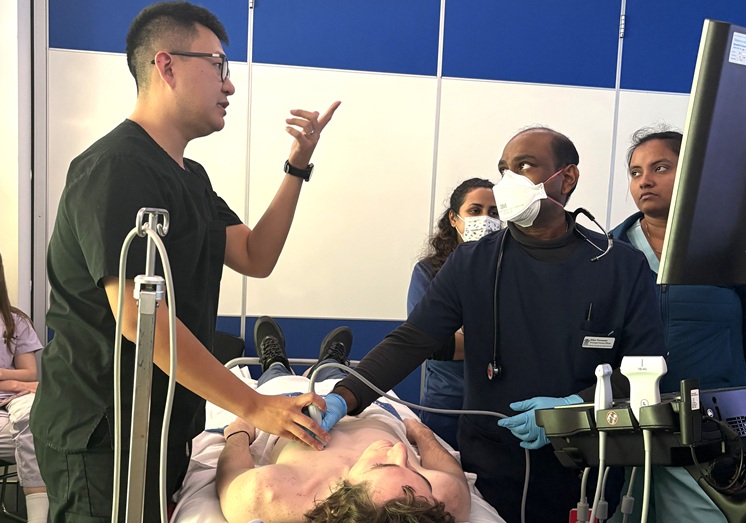
A new in-house critical care ultrasound training and competency pathway is allowing emergency medicine trainees to develop advanced skills while strengthening workforce capability and recruitment, supporting timely clinical decision-making and helping reduce avoidable delays.
Clinical lead for ultrasound in the Mackay Base Hospital Emergency Department (ED), Dr Andy Hua has introduced a structured, supervised ultrasound training pathway for emergency medicine trainees and Fellows of the Australasian College for Emergency Medicine (FACEMs), beginning with Extended Focused Assessment with Sonography in Trauma (eFAST).
The initiative goes beyond teaching doctors how to use an ultrasound machine by supporting trainees to build the supervised experience, logbook and assessment requirements needed to work towards a Certificate in Clinician Performed Ultrasound (CCPU) credential.
Dr Hua said point-of-care ultrasound was an increasingly important skill for emergency clinicians, but access to structured training and supervision could be challenging, particularly outside major metropolitan hospitals.
“There are four core skills for all emergency doctors to know – heart scans, lung scans, EFAST scans and AAA scans,” Dr Hua said.
“For this hospital, the biggest benefit is training our junior doctors and introducing them to EFAST scanning.”
eFAST is particularly valuable in a busy ED, allowing clinicians to rapidly assess seriously injured or unstable patients for signs of internal bleeding or air in the chest.
At Mackay Base Hospital, where emergency clinicians regularly care for trauma patients, the ability to perform the scan at the bedside can help identify patients who need urgent escalation and definitive treatment, Dr Hua said.
Point-of-care ultrasound complements clinical assessment and formal diagnostic imaging. It is used within a structured clinical governance framework, with appropriate supervision, documentation and escalation, and specialist review or comprehensive imaging arranged when clinically indicated.
Dr Hua said increasing the number of clinicians able to perform these scans would benefit both patients and the hospital by reducing delays and enabling faster, more timely escalation of care.
The initial course combines teaching with hands-on scanning, with about one hour dedicated to theory and three hours of practical training.
Rather than relying solely on theoretical learning, trainees practise scanning real patients in a supervised environment. Several James Cook University medical students had volunteered to participate in these practical examinations, Dr Hua said.
Following the course, trainees will complete a logbook of 25 scans on patients in the ED, including five positive scans and three assessment components before being signed off as competent. Clinical decisions will only be based on scans performed with a credentialed supervisor, ensuring trainees develop their skills safely, he said.
The program is aligned with CCPU standards, giving trainees a recognised qualification and removing some of the financial and practical barriers traditionally associated with ultrasound credentialing.
“By bringing that course here and providing it in-house free of charge to our junior doctors, it’s a substantial cost-saving initiative,” he said.
“It’s a drawcard for junior doctors as well, the fact that they can have that training done here.”
The longer-term vision is even more ambitious. Dr Hua wants to establish a dedicated six-month ultrasound term for emergency medicine trainees, allowing doctors to spend significant dedicated time developing their ultrasound skills while continuing to work clinically in the ED.
Dr Hua currently holds 12 CCPU qualifications and plans to use this expertise to develop further training opportunities at Mackay. Future courses could include focused echocardiography in life support and ultrasound-guided nerve blocks, giving emergency specialists additional tools to manage patients, including those with fractures and acute pain.
A high-quality ultrasound term could also become an important recruitment tool by helping attract emergency medicine trainees to the region who want to develop advanced skills, he said. It would also establish an enduring regional training and credentialing pipeline beyond the initial funding period.
The initiative supports Mackay HHS’s broader commitment to strengthening regional emergency and trauma care. Dr Hua said providing high-quality training and supervision locally could help attract and retain clinicians while building skills that support safe, timely patient care across the region.
Most importantly for patients, it would also support earlier clinical decision-making, timely escalation and a reduction in avoidable delays for patients in the ED .
“Offering trainees the chance to gain multiple CCPU qualifications could distinguish Mackay from other regional hospitals and provide a compelling reason for highly motivated candidates to choose the region,” he said.
Dr Hua said the program represented a valuable opportunity to recruit skilled FACEM trainees and was designed with sustainability in mind.
Dr Hua is already working with other emergency specialists undertaking CCPU training, with the aim of building a larger pool of appropriately qualified supervisors.
As more clinicians gain qualifications, they will be able to supervise and train future trainees, creating an in-house capability that can continue to grow.
Ultimately, Dr Hua sees the current eFAST course as the first building block of a much bigger program.
“This is just the starting block – course one of a number of courses of different varieties,” he said.
For trainees, that means gaining practical skills, recognised credentials and valuable experience without leaving the region. For Mackay HHS, it offers another way to develop its workforce, strengthen clinical capability and attract doctors motivated to build advanced emergency medicine skills.
And for Dr Hua, it is an opportunity to build something from the ground up; creating an ultrasound training program for emergency medicine trainees that could rival those offered in metropolitan hospitals.