
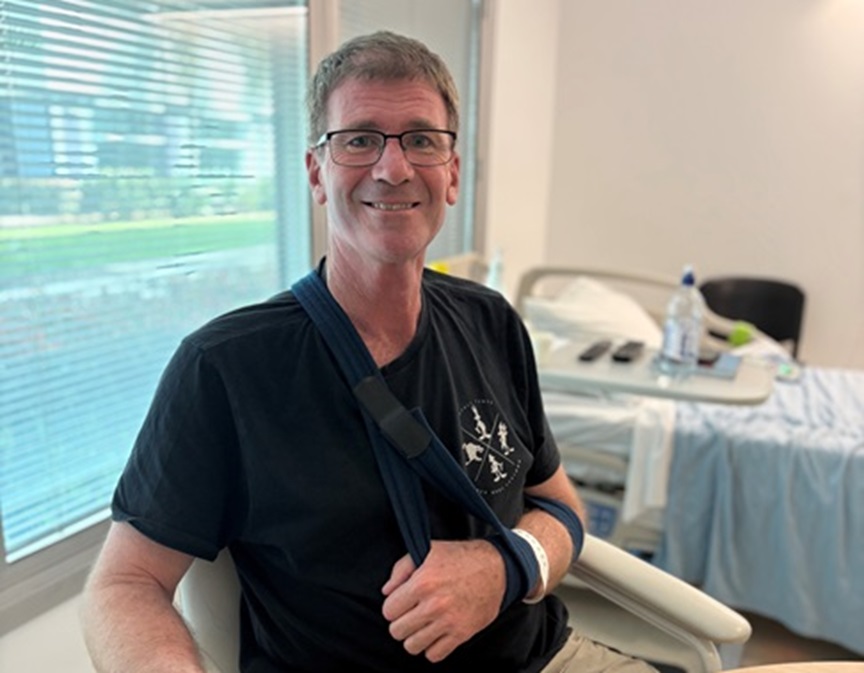
Garreth Plumley admits life has “thrown him a few curveballs” in the last six months.
The 55-year-old Mackay man has spent seven weeks in Mackay Base Hospital after suffering a stroke in early June, which left him paralysed on his left-hand side.
He had recently finished radiation treatment in Townsville after having a cancerous growth removed from his neck, when he woke during the night on June 6 with a very dry mouth and strange tingling in his leg and arm.
Early the next morning, he realised “something really wasn’t right” when he was unable to walk and couldn’t squeeze a fist or lift his arm.
He knew immediately these were symptoms that indicated he was having a stroke.
“It was surreal. I was thinking, ‘this can’t be happening to me, this happens to other people’,” Garreth said.
“I knew the signs of a stroke – FAST (Face drooping, Arm weakness, Speech difficulties and Time to call emergency services), but when it happens to you, you are almost in denial.”
He was taken by ambulance to the Mackay Base Hospital Emergency Department (ED), where tests and a CT scan quickly confirmed the diagnosis.
Garreth was fortunate that this timely medical intervention proved life-saving and also played a crucial role in his recovery from paralysis.
After a second CT two days later, he was admitted to the stroke ward for two weeks.
He began daily sessions with a physiotherapist and an occupational therapist, focusing on regaining motor control through neuroplasticity which is the brain's ability to rewire itself. This process was facilitated by focused, repetitive practice of physical activities and other therapies aimed at strengthening muscles, improving coordination and regaining some range of motion in both his left leg and arm.
“The team in the ED and the stroke unit were just wonderful. I cannot praise the OTs and physios highly enough for their attention and care in my recovery. I was just blown away by the medical attention I received,” he said.
“I’ve had to start from the very beginning and learn to walk again as the stroke killed off so many cells in my brain.”
Garreth was moved to a rehabilitation ward and spent the next five weeks working hard to make steady progress and get out of the wheelchair.
He describes the stroke as “life changing” and said the mental battle was just as tough as the physical one. Discipline and determination were critical elements in his recovery journey.
“You have to stay positive – at least once a day I have a little moment because it’s been an absolute emotional rollercoaster,” Garreth said.
“I did think for a little while ‘why me?’. But then you have a look around and see how much worse off other people are,” he said.
“You’ve just got to give recovery a red-hot go – you’ve got to do the physical work to help, also with the mental load.
“I’m certainly probably one of the younger stroke patients, but regardless, if you don’t stay positive, you will be in a world of pain.”
After what has been a very dark and arduous journey, Garreth still considers himself lucky.
Excited but still nervous, he finally left the hospital and went home on Friday 1 August, ironically just days before National Stroke Week began.
“I can now lift my leg, but still don’t have full movement in my ankle or toes. I have some movement in my fingers, but my arm will take a bit longer,” he said.
“I have exercises to do at home and will continue to visit CHATS here at the hospital twice a week for three hours as an outpatient to continue my rehab.”
Cultivating gratitude for his medical care and many other “small things” had also helped support his psychological resilience and physical recovery after the stroke.
“I’m grateful for my family, for my employer who continues to support me and even the fact that the stroke affected my left side instead of my right as I’m right-handed – the day-to-day struggles could have been so much more difficult,” he said.
“I’m so very grateful to the Base Hospital ED team, to the nurses and doctors on the ward and the OTs and physios – there’s so much to be grateful for. You have to focus on the positives as part of your recovery.
“I’m here, I’m still smiling and I’m making progress – it could have been so much worse.”