
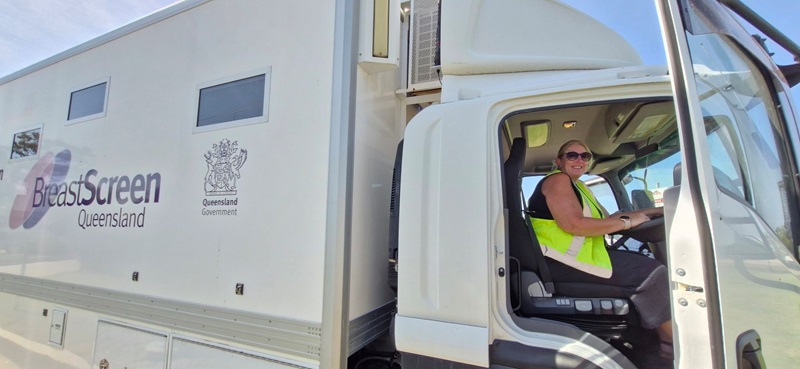
Trish Donnelly is the woman behind the wheel of a mobile service that saves other women’s lives.
As both the casual administration officer and driver of the mobile BreastScreen bus in the Mackay region, Trish is literally driving access to early breast cancer detection for women in regional and rural communities.
Although she doesn’t perform scans or deliver diagnoses, without her, life-saving screening wouldn’t be accessible for the 6000 women who use the service at 20 different locations across the Mackay Hospital and Health Service (HHS) footprint every two years.
Trish is the critical link between logistics and lifesaving care and enjoys the diversity and challenge of the job, knowing that “when Freya the bus arrives in a new town, she will do great things for other women because I parked her there”.
“It is challenging and tiring working on the road and it’s a massive responsibility with so much at stake. It’s not just the worry of mobilising incredibly expensive equipment, but more about making a difference to people’s lives and wellbeing as well,” she said.
“The role is actually quite physical; it’s working outside in the sun and heat, getting hot and sweaty carrying, connecting and disconnecting two 20-metre long electrical cables, climbing up and down and under the truck.
“But I get great satisfaction backing Freya into each new site in the region as well, knowing she has arrived safe, is ready and able to start screening and saving lives.”
Trish, who is originally from Auckland, said when she became a director of a trucking business in Sydney in 2006, she got her Heavy Rigid (HR) licence to help deliver Coca-Cola products across Sydney. She has since worked as a bus and coach driver, a limousine driver, worked for Community Transport in Sydney and been a taxi driver. She also got her motorbike license and started riding in her 30s.
Trish moved to Mackay in 2024 and started with BreastScreen in August last year.
The mobile service offers free, 30-minute breast screening for women (specifically aged 50–74) across the Mackay, Whitsunday and Isaac regions. Navigating rural roads could sometimes be a challenge which required serious concentration, she said.
While women are clearly the primary clients of the mobile service and radiographers are female-only for clinical reasons, as a driver of a heavy vehicle, Trish is aware she’s in the minority.
“I do get a few surprised expressions and some comments when I pull up and jump out of the BreastScreen bus, but they are always very positive and welcoming,” she said.
“In my admin role, I get to engage with our clients directly and I work with some wonderful supportive ladies who are fun to be around and have really welcomed me as the driver too.
“It’s really very satisfying to know we’re part of a team out on the road bringing breast screening closer to women in our rural communities and providing them with access to this lifesaving service.”
MACKAY BREASTSCREEN FACT BOX
- BreastScreen Mackay bus has travelled 11,000km.
- Travels 1800 kilometres per year.
- Visits 20 sites across the HHS.
- Screens 6000 women every two years.
- Accounts for 30 per cent of total screening activity for BreastScreen Mackay.
- About 680 breast screens are performed every day across Queensland.
- 5.5 million screens have occurred in Queensland since 1991 with more than 27,000 breast cancers diagnosed.