
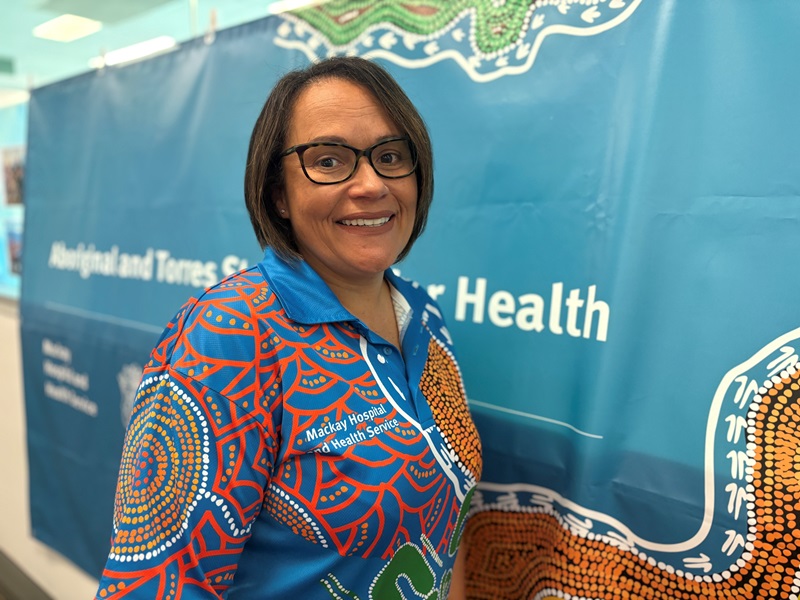
When Lyndell Sheehan stepped into the role of Health Equity Project Manager at Mackay Hospital and Health Service (HHS) in July, it felt like her career journey had come full circle.
Born and raised in Mackay, Lyndell’s professional path has been driven by one consistent passion: creating opportunities for people to thrive.
After initially studying teaching in Rockhampton, Lyndell realised it wasn’t her long-term path. Instead, she moved to Canberra where she worked with the Aboriginal and Torres Strait Islander Commission for four years before accepting a regional posting back in Rockhampton.
In 1998 she returned to Mackay to be closer to family and began working as an authorised officer in early childhood compliance for the Department of Families, which later transitioned to the Department of Education in 2008. She was responsible for ensuring childcare centres, family day care schemes and after-school services met licensing and legislative requirements. She later moved into a role within the Department of Employment, Small Business and Training, working with employers and apprentices to ensure compliance with employment and training legislation.
What has remained constant throughout her career is a deep connection to community and First Nations families.
While working with the Department of Education, Lyndell was involved in key initiatives such as Elders as Storytellers and the First 5 Forever campaign, programs designed to encourage early learning, positive engagement and strong transitions into kindy and prep.
This experience, she said, mirrors the challenges she sees in healthcare and attracted her to the role of Health Equity Project Manager.
“Some parents haven’t had good experiences as a child with education,” she said.
“Healthcare is similar as people can be fearful of going to the hospital, or feel unsafe about what might happen once they’re there, or not coming home.
“My role is about helping to identify and break down those barriers and to help to ensure our health services are accessible, welcoming, supportive and providing culturally safe care.”
Lyndell sees her role as one of both connection and education – not only with community, but also with clinicians.
“Part of our job is walking alongside healthcare teams so they understand cultural aspects and can communicate respectfully,” she said.
“For example, for Torres Strait Islanders, English is often a second language, so we need to make sure people feel heard and supported. Ultimately, it’s about patient care and creating quality outcomes.”
Her new scope of work involves guiding the review of the Mackay HHS Health Equity Strategy (2022–2025) and shaping the next three-year strategy. With 42 existing priorities, consultation with First Nations staff, prescribed stakeholders, Traditional Custodians, clinicians and community members will be critical to the HHS and strategy’s future direction.
Lyndell’s own cultural heritage reflects the diversity of her work.
On her paternal side, her grandfather was Goreng Goreng from the Bundaberg and Rockhampton region, and her grandmother was an Australian South Sea Islander. Her mother is of Italian and English heritage, while Lyndell’s husband has Irish heritage.
What inspires her but also grounds her most is the importance of kinship, connection and storytelling.
“Elders’ stories are vital – they hold knowledge, history and guidance that can be passed down through generations,” she said.
“The real challenge is finding the balance between respecting and sharing those stories while also trying to change the narrative about education and healthcare for First Nations communities.”
For Lyndell, the project manager role is both exciting and somewhat daunting. The scope may be broad and the priorities many, but her passion for making a difference in both the role and to the First Nations community is clear.
“If we can make healthcare more accessible, more culturally safe and more connected to the community, then we can truly improve outcomes,” she said.
That’s the challenge and opportunity ahead, she’s ready to embrace.