
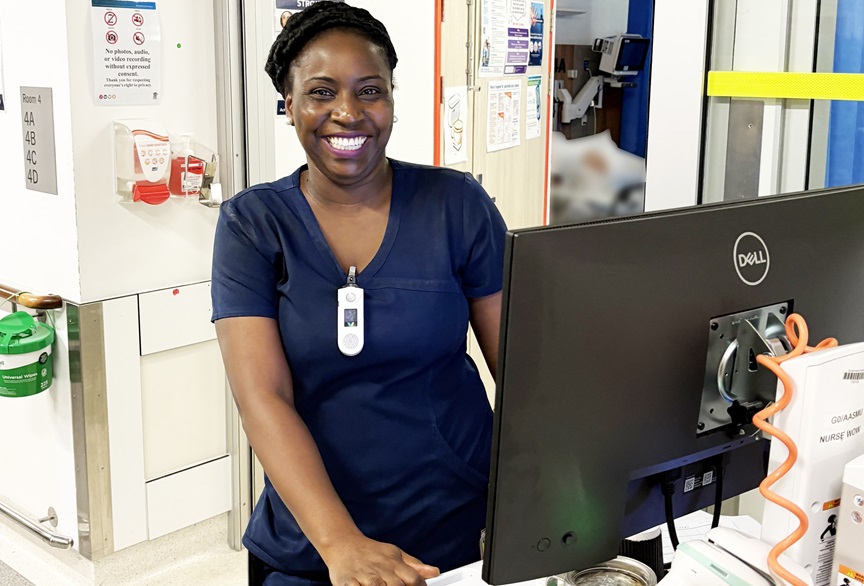
Helen Nengasha is no stranger to “jumping in the deep end”.
From moving continents to changing careers and ultimately stepping into a nursing leadership role and driving clinical change at Mackay Base Hospital, she enjoys a challenge and getting out of her comfort zone.
The nurse navigator has just celebrated her 10-year Length of Service with Mackay Hospital and Health Service (HHS) after originally moving to Australia from Zimbabwe in 2009. With two young children then it was a significant step, one which saw her leave behind a teaching career and the support of extended family to relocate to Queensland and provide a better life for her family.
It also kickstarted a new life chapter when she pursued her childhood dream and began studying nursing at Central Queensland University (CQU) and later at Griffith University. It was an enormous career pivot after teaching primary school children in Zimbabwe.
“I did really enjoy teaching children back then, but now I enjoy the teaching side of nursing,” she said.
Since starting at Mackay Base Hospital in January 2014, Helen’s career has flourished. Her love for education saw her transition from a registered nurse to working as a clinical nurse and then clinical facilitator in the stroke unit, mentoring staff and students alike.
Her role as nurse navigator is both demanding and deeply rewarding and sees her coordinating and supporting patients throughout their stroke care journey. She is a consistent point of contact, ensuring patients and their families receive timely and appropriate care, navigating the healthcare system and accessing necessary resources.
“The stroke ward is very heavy emotionally and mentally,” Helen said.
“But teamwork is everything. We feel like a family here and that support makes the hardest days easier. Chocolate cake helps too.”
Helen’s role is integral to the entire patient journey, beginning from when a patient arrives in the Emergency Department (ED) with acute stroke symptoms, through to imaging, treatment, secondary prevention, rehabilitation and discharge.
Unlike other larger tertiary hospitals, Mackay doesn’t not have a dedicated stroke team, so Helen works closely with doctors, ED staff, allied health professionals and nursing colleagues to ensure rapid assessments, prompt imaging and coordinated care.
“It’s like putting together a puzzle,” she said. “The brain has always fascinated me — how different parts control different functions. Finding a tiny clot and solving the problem is a challenge, but that’s what makes it interesting.”
Helen is particularly concerned about the rising number of younger stroke patients, some as young as 18 or 19.
“Stroke isn’t just an old person’s disease,” she said. “We are seeing more younger patients, but those under 65 have a better chance of recovery because of brain neuroplasticity, but lifestyle choices like smoking, poor diet, and lack of exercise play a big role.”
Patient recovery was one of the most moving aspects of her job.
“Seeing someone walk out of here and going home after a stroke is incredible,” Helen said.
“Sometimes they arrive paralysed and then to be able to walk out after a lot of hard work and rehab — that’s very emotional for everyone.”
One of the greatest challenges of the role was helping patients and families face difficulties beyond the visible physical symptoms of a stroke and to come to terms with a new reality.
“People often don’t understand what having a stroke means,” Helen said.
“There are physical changes often of course, but there’s also so many unseen effects like emotional changes, depression, and anxiety. Educating patients and their families also is crucial because they live with these changes every day.”
Being a Nurse Navigator demands constant advocacy, relationship-building and education, but Helen is also passionate about driving change. She is determined Mackay Base Hospital is working towards stroke accreditation, a process which involves rigorous reviews, audits and feedback, which can lead to continuous quality improvement in stroke care delivery.
Time is critical and from “door to needle,” meaning the time from hospital arrival to administering clot-busting medication, Helen and her team are now working hard to meet the average regional Key Performance Indicator for accreditation of 105 minutes.
“It’s not just about me — it’s about making the system better, improving outcomes for patients and helping the hospital get recognised for the care we deliver,” she said.
“I like to be involved and be hands-on in this process — if I’m talking about improving processes and accreditation, I need to be part of the delivery too. It builds better teamwork and respect.”
Helen is passionate about driving change and educating colleagues about the importance of quick stroke recognition and timely CT scans.
“Time is brain,” she said, “and every minute we save in early assessment means 1.9 million brain cells are preserved.”
As Helen continues her work towards stroke certification and refining the hospital’s key performance indicators, she remains steadfast in her commitment and determination to improve the standards of stroke care delivered at rural sites.
“I’m still finding my voice as a nurse navigator, but every step is worth it if it means a patient gets the best chance to recover and reclaim their life.”