
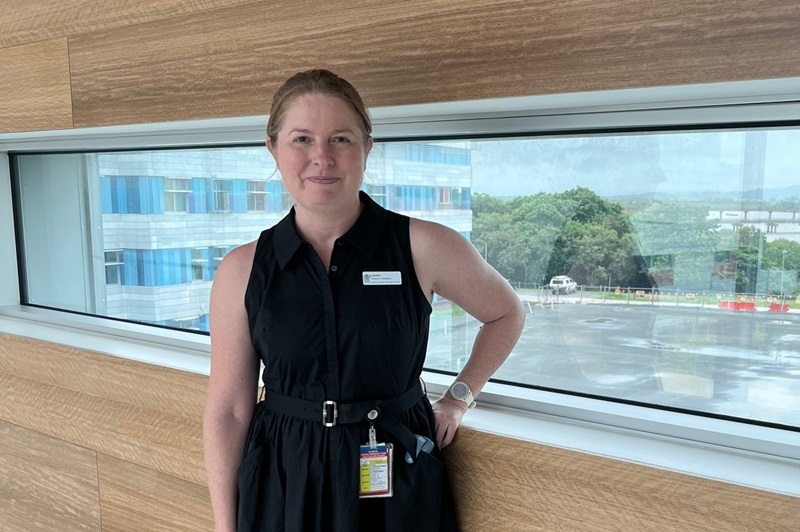
Louise Moodie was contemplating a career in meteorology before she stumbled upon the concept of using food as medicine.
Now the Director of Nutrition and Dietetics is ‘forecasting’ how calories, clinical services, culture and communication can significantly improve patient care and outcomes at Mackay Hospital and Health Service (HHS).
On International Day of Women and Girls in Science (February 11), Louise shared how an early interest in maths and science had developed into a career in the evolving field of dietetics and helped her break down perceived gender barriers.
From dietitians to allied health assistants, food services staff, and other clinicians who need nutrition knowledge, Louise and her team work alongside other teams to support patient care. Her role includes advocating for the profession, strengthening and expanding Mackay HHS, and developing the current and future workforce.
“I originally planned to become a meteorologist, but a sports nutrition project in Year 12 in my ‘easy’ subject - home economics, changed my direction while keeping me in the science field,” Louise said.
“I actually didn’t study biology or chemistry in high school but my passion for the career path pushed me all the way to complete a Master of Nutrition and Dietetics.
“I’ve been fortunate to have parents who nurtured my interests in science and maths and to now have a strong professional network of women across Australia who are doing incredible work in the STEM sector.
“I’ve also had a number of supportive male colleagues who acted as allies, something that remains essential for breaking down both real and perceived barriers.”
According to UNESCO Institute for Statistics (UIS), globally, women in science remain underrepresented, making up less than 30 per cent of researchers. In Australian, that figure decreases with women in science accounting for only 17 per cent of STEM study enrolments and just 29 per cent of the STEM workforce.
Louise’s advice to those considering a career in science is simple; Go for it.
“Identify mentors and have a positive give it a go attitude,” she said.
“STEM shapes every part of our lives, and the pace of change is extraordinary.
“Food as medicine is centuries old but the evidence behind this is relatively young and evolving rapidly.
“The work of a dietitian today will look very different in 10 years, which makes it such an exciting time to join the profession.
“The greatest satisfaction for me comes from the impact we have on patients’ lives. Every patient teaches me something, whether it’s about clinical care, food, culture, communication, or how we can improve our services”.
Louise is currently working as site lead and Chief Investigator on a Deakin University research project developing and validating a screening tool to identify cancer‑related low muscle mass.
“Up to 50% of people with cancer experience low muscle mass, yet it often goes unrecognised and untreated, despite its impact on treatment tolerance and survival,” she said.
“What excites me most, is that the majority of the participating sites in this research are rural or regional, which is not a common occurrence.
Once the tool is developed and implemented, Mackay will be one of the first regions globally to benefit from this work, improving the overall treatment effectiveness and patient longevity.