
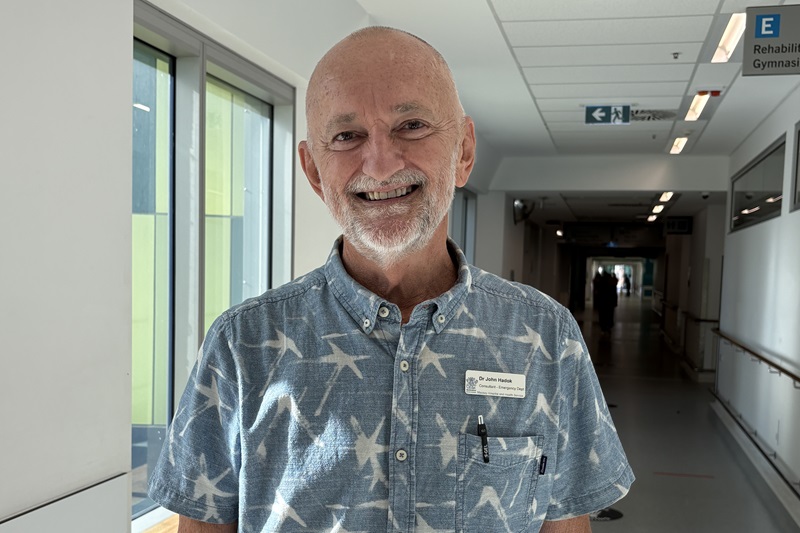
After more than four decades of service, Dr John Hadok is retiring from Mackay Base Hospital, bringing down the curtain on a remarkable career that has spanned emergency medicine, retrieval services, education, digital health, rural medicine and contributions to performing arts.
Dr Hadok first arrived at Mackay Base Hospital as an intern in 1984, initially intending to stay for only 12 months. Instead, he built a 42-year career dedicated to caring for patients, supporting colleagues and advancing healthcare services across the region.
He recalls a very different hospital environment in the 1980s, where interns often worked independently overnight across intensive care, coronary care and maternity services, relying heavily on the experience and support of nursing staff. Emergency medicine was still known simply as ‘casualty’, technology was limited and retrieval systems were in their infancy.
Following his internship, Dr Hadok spent time working as a solo country reliever across Southwest Queensland, providing emergency care, anaesthesia, obstetrics and trauma support to remote communities, often without specialist backup or retrieval services.
After another year at Mackay Base Hospital, Dr Hadok and his wife Janice travelled to the United Kingdom, where he began anaesthesia training in the National Health Service (NHS). The demanding pace and pressures of the NHS eventually prompted him to step away from medicine temporarily, leading to a colourful chapter working as a dishwasher in a London restaurant and painting houses for a prisoners’ rehabilitation trust.
Dr Hadok often reflected on the irony that he earned more per hour washing dishes than administering anaesthetics. Restaurant patrons, many from London’s Foreign Office, would regularly seek medical advice from him while he stood elbow-deep in suds at the sink.
Following his return to Australia in 1989, Dr Hadok and Janice both secured temporary positions back in Mackay. Dr Hadok was appointed permanently in 1990 and remained a valued member of the Mackay Base Hospital medical workforce ever since.
Throughout his career, Dr Hadok played a significant role in developing and improving healthcare services locally and across regional Queensland.
He helped establish Mackay’s Birth Centre in 1994 and chaired committees focused on alternative birthing services and homebirth consultation. He also introduced trauma training and major incident response programs to the hospital and became an instructor in Emergency Management of Severe Trauma (EMST).
Dr Hadok was heavily involved in the early development of retrieval medicine in Central Queensland, conducting road, fixed-wing and helicopter retrievals long before modern retrieval systems were established. He was part of the foundation of CQ RESQ, the precursor to today’s helicopter rescue service, and chaired several operational and safety committees.
His career also included international work as medical director for North Asian operations with International SOS, coordinating medical evacuations throughout Asia and leading medical services during the United Nations Fourth World Conference on Women in Beijing.
Within Mackay HHS, Dr Hadok held numerous leadership and clinical roles including locum Director of Emergency Department, Director of Clinical Training, Director of Rural Generalist Training, Clinical Lead for Telehealth and inaugural Senior Medical Officer for Hospital in the Home.
A passionate educator, Dr Hadok contributed to curriculum development for both James Cook University and the Australian College of Rural and Remote Medicine (ACRRM). He is a foundation Fellow of ACRRM and several faculties of the Royal College of Surgeons of Edinburgh.
He also became a strong advocate for more compassionate and patient-centred approaches to care, pioneering techniques to reduce distress for children undergoing emergency procedures and promoting the role of humanities and narrative medicine in clinical practice.
Outside medicine, Dr Hadok’s love of music and theatre led him to found the Australian Society for Performing Arts Healthcare, now Australia’s peak body in the field.
Over the course of his career, Dr Hadok received numerous honours including the British Association for Immediate Care Medal and the Pride of Australia award for his involvement in the rescue of shark attack victim Justine Barwick.
A farewell afternoon tea was held yesterday, attended by many medical colleagues past and present, including his first Mackay Base Hospital medical supervisor, mentor and former emergency department director Dr Bert Sadleir.
Reflecting on his career, Dr Hadok said he considered himself “one of the luckiest people around”.
“For many years I have been paid to do what I love, that being ministering to the sick and injured, teaching the next generations of clinicians and serving a growing hospital, health service and community,” he said.
His guiding principles throughout his career were both ancient and modern: ‘Primum Non Nocere’ (First, Do No Harm) and Emily Dickinson’s words, ‘If I can stop one heart from breaking, or ease one pain, I have not lived in vain’.
Dr Hadok said the many people he had worked with and learnt from over the decades would remain with him always.
“The tapestry of all those threads will stay in pride of place on the wall of my soul as I look for my next adventures,” he said.
Mackay HHS and our community extends our sincere thanks to Dr John Hadok for his extraordinary contribution to healthcare and wishes him every success in his retirement and future adventures.